7 Meal Plans for Weight Loss, With the Calories Worked Out
Below are seven sample days of ordinary meals at stated calorie levels, from about 1,400 to 2,200 calories. Every number was calculated from USDA food data. Pick a level close to your own estimate, then swap foods to suit your tastes.
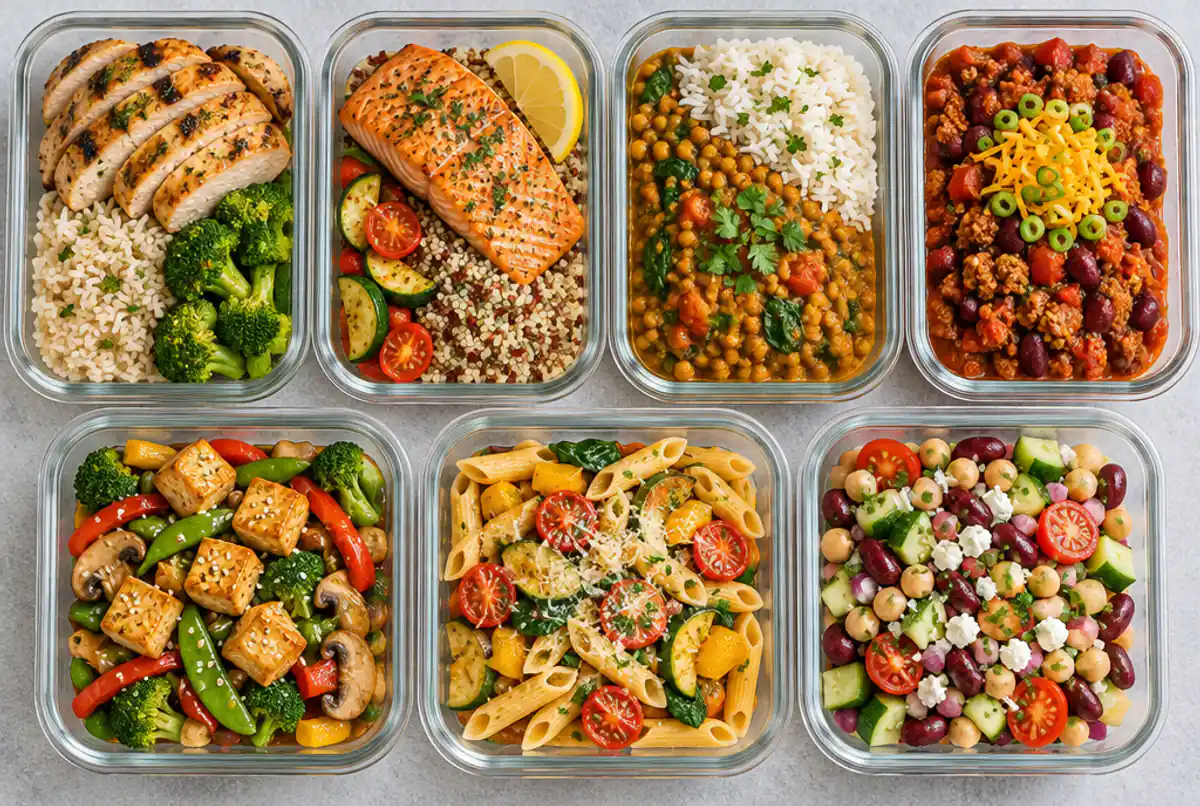
The seven days at a glance
| Day | Calories | Protein (g) | Fat (g) | Carbs (g) | Fiber (g) | Sodium (mg) |
|---|---|---|---|---|---|---|
| Day 1: about 1,400 calories | 1,394 | 82 | 44 | 173 | 27 | 676 |
| Day 2: about 1,400 calories | 1,398 | 97 | 45 | 161 | 41 | 935 |
| Day 3: about 1,600 calories | 1,619 | 87 | 69 | 181 | 31 | 975 |
| Day 4: about 1,600 calories | 1,618 | 100 | 41 | 221 | 39 | 297 |
| Day 5: about 1,850 calories | 1,845 | 94 | 71 | 222 | 47 | 817 |
| Day 6: about 2,050 calories | 2,056 | 129 | 72 | 230 | 44 | 966 |
| Day 7: about 2,200 calories | 2,224 | 128 | 95 | 241 | 47 | 1,509 |
Estimate based on USDA FoodData Central (how we calculate). Sodium excludes any salt you add.
Day 1: about 1,400 calories
Breakfast (333 calories)
- Rolled oats (dry): 50 g
- 1% milk: 240 g
- Blueberries: 75 g
Lunch (339 calories)
- Whole-wheat bread, 2 slices: 64 g
- Hard-boiled eggs, 2: 100 g
- Romaine lettuce: 40 g
- Tomato: 90 g
Snack (276 calories)
- Apple: 180 g
- Almonds: 28 g
Dinner (446 calories)
- Roast chicken breast: 100 g
- Brown rice (cooked): 150 g
- Broccoli (boiled): 150 g
- Olive oil: 5 g
Day 2: about 1,400 calories
Breakfast (316 calories)
- Greek yogurt, low-fat: 200 g
- Strawberries: 150 g
- Almonds: 21 g
Lunch (521 calories)
- Lentils (cooked): 200 g
- Spinach: 60 g
- Red pepper: 100 g
- Olive oil: 10 g
- Whole-wheat bread, 2 slices: 64 g
Snack (157 calories)
- Orange: 140 g
- Cottage cheese, 2%: 113 g
Dinner (404 calories)
- Salmon (cooked): 110 g
- Baked sweet potato: 150 g
- Broccoli (boiled): 120 g
Day 3: about 1,600 calories
Breakfast (458 calories)
- Whole-wheat toast, 2 slices: 64 g
- Peanut butter: 32 g
- Banana: 118 g
Lunch (418 calories)
- Tuna, canned in water: 120 g
- Romaine lettuce: 60 g
- Cucumber: 100 g
- Tomato: 90 g
- Olive oil: 10 g
- Quinoa (cooked): 150 g
Snack (183 calories)
- Carrots: 100 g
- Hummus: 60 g
Dinner (560 calories)
- Firm tofu: 150 g
- White rice (cooked): 150 g
- Red pepper: 100 g
- Broccoli (boiled): 100 g
- Olive oil: 10 g
Day 4: about 1,600 calories
Breakfast (476 calories)
- Rolled oats (dry): 50 g
- 1% milk: 240 g
- Banana: 118 g
- Almonds: 14 g
Lunch (505 calories)
- Black beans (cooked): 170 g
- Brown rice (cooked): 150 g
- Avocado: 50 g
- Tomato: 90 g
Snack (167 calories)
- Greek yogurt, low-fat: 170 g
- Blueberries: 75 g
Dinner (470 calories)
- Roast chicken breast: 120 g
- Baked potato: 170 g
- Romaine lettuce: 60 g
- Cucumber: 100 g
- Olive oil: 10 g
Day 5: about 1,850 calories
Breakfast (462 calories)
- Hard-boiled eggs, 2: 100 g
- Whole-wheat toast, 2 slices: 64 g
- Avocado: 50 g
- Orange: 140 g
Lunch (613 calories)
- Chickpeas (cooked): 160 g
- Quinoa (cooked): 185 g
- Spinach: 60 g
- Red pepper: 100 g
- Olive oil: 10 g
Snack (217 calories)
- Pear: 180 g
- Cheddar: 28 g
Dinner (553 calories)
- Salmon (cooked): 120 g
- Whole-wheat pasta (cooked): 140 g
- Broccoli (boiled): 150 g
- Olive oil: 5 g
Day 6: about 2,050 calories
Breakfast (472 calories)
- Rolled oats (dry): 60 g
- 1% milk: 240 g
- Peanut butter: 16 g
- Strawberries: 150 g
Lunch (773 calories)
- Flour tortillas, 2: 72 g
- Lean ground beef (cooked): 100 g
- Black beans (cooked): 130 g
- Romaine lettuce: 40 g
- Tomato: 90 g
- Cheddar: 28 g
Snack (276 calories)
- Apple: 180 g
- Almonds: 28 g
Dinner (535 calories)
- Roast chicken breast: 130 g
- Baked sweet potato: 200 g
- Broccoli (boiled): 150 g
- Olive oil: 10 g
Day 7: about 2,200 calories
Breakfast (517 calories)
- Greek yogurt, low-fat: 200 g
- Rolled oats (dry): 40 g
- Blueberries: 100 g
- Almonds: 28 g
Lunch (543 calories)
- Whole-wheat bread, 3 slices: 96 g
- Tuna, canned in water: 140 g
- Mayonnaise: 15 g
- Romaine lettuce: 40 g
- Orange: 140 g
Snack (391 calories)
- Carrots: 120 g
- Hummus: 100 g
- Banana: 118 g
Dinner (774 calories)
- Firm tofu: 180 g
- Whole-wheat pasta (cooked): 200 g
- Spinach: 60 g
- Red pepper: 100 g
- Olive oil: 20 g
How to choose a calorie level
There is no single right number. The 2013 adult obesity guideline from the American Heart Association, American College of Cardiology and The Obesity Society describes reduced-calorie diets of about 1,200 to 1,500 calories a day for women and 1,500 to 1,800 for men, adjusted for body weight, usually aiming for a deficit of at least 500 calories a day below what you need to maintain your weight. Larger or more active people need more.
To find your own starting point, use the daily nutrition needs calculator. It estimates your maintenance calories and, if your BMI is 25 or more, a weight-loss target that never goes below 1,200 calories (women) or 1,500 (men).
What to expect
We cannot promise how much weight you will lose: bodies differ. The CDC notes that people who lose weight gradually and steadily, about 1 to 2 pounds a week, are more likely to keep it off. Weigh yourself once a week at the same time of day rather than every day, and adjust portions if your weight is not moving after a few weeks.
Make it yours
- Swap like for like. Chicken for tofu, salmon for tuna, brown rice for quinoa. To see what a swap does to the numbers, paste the day into the recipe nutrition calculator.
- Scale portions, not meals. If you need about 1,800 calories, start with a 1,600 day and add a snack such as a piece of fruit with a small handful of nuts.
- Keep the pattern. The days follow the general shape of the DASH eating plan from the National Heart, Lung, and Blood Institute: plenty of vegetables, fruit and whole grains, with fish, poultry, beans, nuts and vegetable oils.
- Salt and seasoning are not included in the numbers. Herbs, spices, lemon and vinegar add flavor with almost no calories.
How the numbers were calculated
Every food was matched to an entry in USDA FoodData Central and weighed in grams. The calories and nutrients for each meal and day were added up by the same engine that runs our recipe calculator, when this page was built. Cooked foods (rice, pasta, beans, chicken, salmon) use USDA’s cooked entries, so weigh them after cooking. The totals are estimates: brands and cooking change the numbers a little.
Daily Nutrition Needs Calculator: find your own calorie number before picking a plan.