Foods for Circulation and Heart Health: What the Evidence Supports
No single food has been shown to "improve circulation". The strongest evidence is for an overall eating pattern, such as DASH, which lowers blood pressure and LDL cholesterol in trials. For individual foods the evidence ranges from modest effects on blood pressure to observational links, and for some popular choices it is weak.
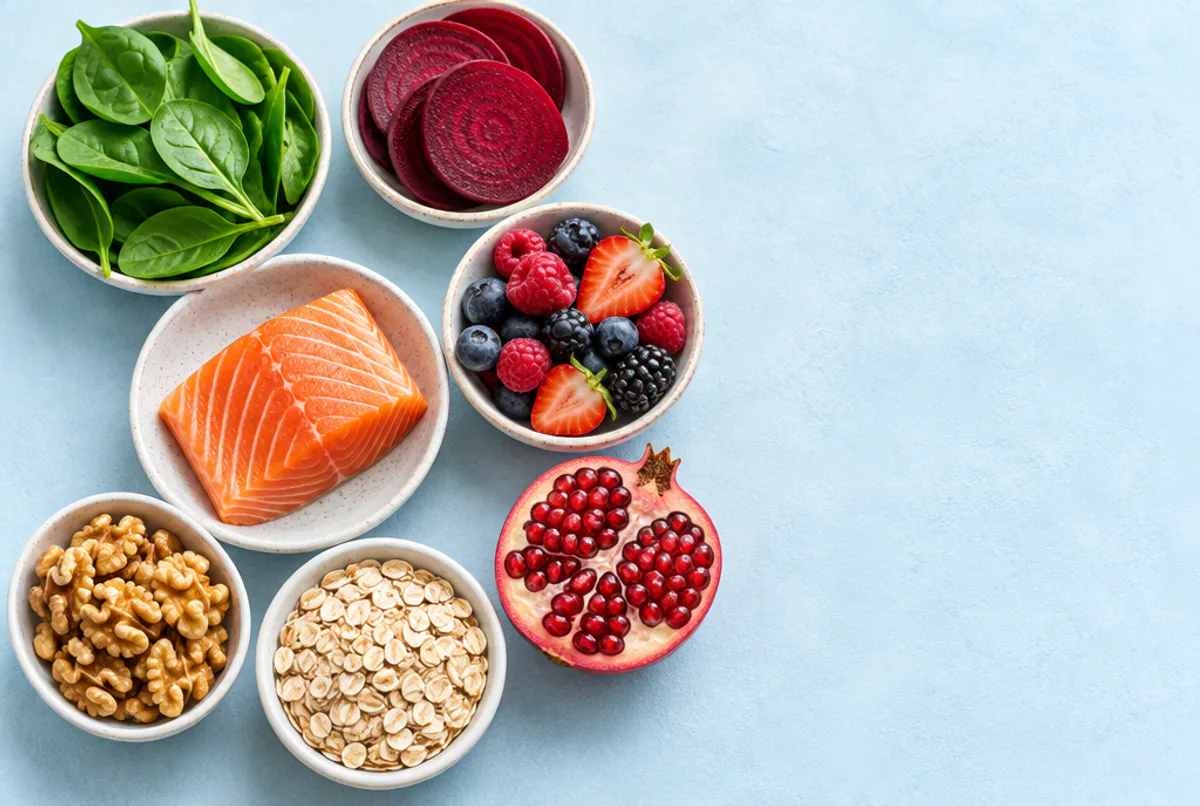
The evidence, food by food
The DASH eating pattern · Evidence: Strong
In the DASH trial, 459 adults who ate the DASH diet for 8 weeks had the largest drop in blood pressure, and LDL cholesterol also fell. Cutting sodium as well lowered blood pressure further. A 2025 Cochrane review agrees DASH may lower blood pressure and cholesterol, but says its effect on heart attacks, strokes and deaths remains inconclusive because long-term evidence is lacking.
Oily fish and omega-3 fats · Evidence: Some
A 2022 analysis of 71 trials found omega-3 intakes of 2 to 3 grams a day lowered systolic blood pressure by about 2.6 mmHg on average, more in people with high blood pressure. Most trials used supplements, not whole fish.
Nuts · Evidence: Some
A 2019 review of 19 cohort studies found people who ate the most nuts had about 15% less cardiovascular disease and 23% lower cardiovascular death than those who ate the least. These are observational links, and the authors rated certainty from moderate to very low.
Leafy greens · Evidence: Weak
A 2016 single-author analysis of 8 observational studies linked higher intake of green leafy and cruciferous vegetables with about 16% less cardiovascular disease. We did not find a systematic review on nitrate-rich vegetables such as beetroot and blood pressure, so that popular claim is not graded here.
Berries · Evidence: Some
A 2016 analysis of 22 trials with 1,251 people found berries lowered LDL cholesterol a little and systolic blood pressure by about 2.7 mmHg. Other markers did not change.
Cocoa and dark chocolate · Evidence: Some
A 2017 Cochrane review rated as moderate-quality the evidence that flavanol-rich cocoa products cause a small blood pressure drop, about 2 mmHg, in mostly healthy adults in the short term. It noted some reporting bias and a lack of long-term trials. Chocolate also brings sugar, fat and calories.
Olive oil · Evidence: Some
A 2015 review of 30 studies found olive oil improved flow-mediated dilation (how well arteries widen) and lowered a marker of inflammation. The authors asked for a conservative reading because the studies differed a lot.
Whole grains · Evidence: Some
A 2016 BMJ review of prospective studies linked each extra 90 g of whole grains a day (about three servings) with 19% less coronary heart disease and 22% less cardiovascular disease. The link with stroke was not statistically clear. These are observational findings.
Beans and other legumes · Evidence: Weak
A 2017 review of 6 cohort studies found higher legume intake was linked with slightly lower death from all causes, but not with cardiovascular death. The authors called the evidence inconclusive. Beans are still part of the DASH pattern.
Garlic · Evidence: Weak
A 2015 analysis of 17 trials found garlic supplements lowered blood pressure, mainly in people with high blood pressure. The trials tested supplements, not garlic used in cooking, so they do not show that eating garlic has the same effect.
Citrus fruit · Evidence: Weak
A 2021 review of 45 trials found benefits for some berries and cherry juice, but no significant improvement for citrus. Claims that oranges or lemons improve circulation are not supported by this review.
Nutrients per serving
| Serving | Calories | Fiber (g) | Sat. fat (g) | Potassium (mg) | Sodium (mg) |
|---|---|---|---|---|---|
| 100 g cooked Atlantic salmonUSDA: Fish, salmon, Atlantic, farmed, cooked, dry heat | 206 | 0.0 | 2.4 | 384 | 61 |
| 28 g (1 oz) almondsUSDA: Nuts, almonds | 162 | 3.5 | 1.1 | 205 | 0 |
| 30 g raw spinach (about 1 cup)USDA: Spinach, raw | 7 | 0.7 | 0.0 | 167 | 24 |
| 75 g blueberries (about 1/2 cup)USDA: Blueberries, raw | 43 | 1.8 | 0.0 | 58 | 1 |
| 28 g dark chocolate, 70–85% cacaoUSDA: Chocolate, dark, 70-85% cacao solids | 167 | 3.1 | 6.9 | 200 | 6 |
| 1 tablespoon (14 g) olive oilUSDA: Oil, olive, salad or cooking | 124 | 0.0 | 1.9 | 0 | 0 |
| 40 g rolled oats, dry (1/2 cup)USDA: Cereals, oats, regular and quick, not fortified, dry | 152 | 4.0 | 0.4 | 145 | 2 |
| 86 g cooked black beans (1/2 cup)USDA: Beans, black, mature seeds, cooked, boiled, without salt | 114 | 7.5 | 0.1 | 305 | 1 |
| 1 clove (3 g) raw garlicUSDA: Garlic, raw | 4 | 0.1 | 0.0 | 12 | 1 |
| 1 medium orange (140 g)USDA: Oranges, raw, all commercial varieties | 66 | 3.4 | 0.0 | 253 | 0 |
Estimate based on USDA FoodData Central (how we calculate). n/r = not reported by USDA for this food.
Where “improves circulation” goes beyond the evidence
Most research on food and the heart measures risk factors such as blood pressure and LDL cholesterol, or follows large groups of people to see who develops heart disease. Very little measures “circulation” directly. The closest is flow-mediated dilation, a test of how well an artery widens, which was used in some of the olive oil trials.
So when a food is sold as something that “boosts circulation”, ask what was actually measured. Often the honest answer is “a small drop in blood pressure over a few weeks”, or “people who ate more of it had less heart disease, which may have other causes”.
How we graded the evidence
- Strong: randomized controlled trials show a clear effect on a risk factor, and the food is part of a pattern recommended by a national health body.
- Some: a systematic review shows a modest effect on a risk factor in trials, or a consistent link in large observational studies, with stated limits.
- Weak: the review found no clear effect, the studies tested supplements rather than food, or the evidence is thin.
One review per food was read in full abstract for this page. Grades reflect those reviews and the limits their authors state, not every study ever published.
How to use this
If you want one change with the best evidence, it is the eating pattern rather than any single food. The National Heart, Lung, and Blood Institute’s DASH plan emphasizes vegetables, fruit and whole grains; includes low-fat dairy, fish, poultry, beans, nuts and vegetable oils; and limits foods high in saturated fat, sugar-sweetened drinks and sweets, and sodium. To see what a day of eating like this adds up to, try the recipe nutrition calculator or the sample meal plans.
If you have high blood pressure, heart disease or take medicines such as blood thinners, talk to your clinician before making big changes or taking supplements.
Recipe Nutrition Calculator: see the calories, fiber, sodium and potassium in your own heart-healthy recipes.