Table of Contents
Every mother wants to give her baby the best possible start in life. And one of the most powerful things you can do during pregnancy is eat the right foods to fuel your baby’s brain development.
The human brain begins forming just weeks after conception. By the time you reach the third trimester, your baby’s brain is growing at a rate of 250,000 neurons per minute. The nutrients you eat directly influence how well those neurons form, connect, and communicate.
This guide covers the best pregnancy brain development foods — backed by research — along with practical meal ideas and a free tool to help you plan every week of your pregnancy.
How Pregnancy Nutrition Shapes Your Baby’s Brain
Your baby’s brain development happens in stages across all three trimesters:
- Weeks 3–4: Neural tube forms — folate and choline are critical here
- Weeks 6–24: Neurons multiply rapidly — DHA and iron fuel this growth
- Weeks 24–40: Brain connections (synapses) form and strengthen — omega-3 fats, zinc, and iodine are essential
Deficiencies in key nutrients during these windows can have lasting effects on your child’s cognitive development, memory, and even emotional regulation. The good news: targeted food choices make a real difference.
Omega-3 Rich Foods: The Brain’s Building Blocks
Omega-3 fatty acids are the most important nutrient for fetal brain development. Approximately 60% of the brain is made up of fat — and DHA (a type of omega-3) makes up a significant portion of that fat, particularly in the cerebral cortex and retina.
Top Omega-3 Foods During Pregnancy
| Food | Omega-3 (DHA+EPA) per serving | Notes |
|---|---|---|
| Salmon (wild, cooked, 3oz) | 1,500–2,000 mg | Best overall source |
| Sardines (canned, 3oz) | 1,100 mg | Budget-friendly, very safe |
| Mackerel (Atlantic, 3oz) | 1,000 mg | Avoid king mackerel (high mercury) |
| Trout (farmed, 3oz) | 900 mg | Safe, mild flavour |
| Herring (3oz) | 1,700 mg | Excellent but strong taste |
| Shrimp (3oz) | 300 mg | Low mercury, easy to cook |
| Walnuts (1oz / 14 halves) | 2,570 mg ALA | Plant-based, converts to DHA partially |
| Flaxseeds (1 tbsp ground) | 1,600 mg ALA | Best added to smoothies or oatmeal |
| Chia seeds (1 oz) | 5,060 mg ALA | Versatile, easy to use daily |
| Algae oil supplement | 200–300 mg DHA | Vegan DHA — same source as fish |
How Much Omega-3 Do You Need in Pregnancy?
The American College of Obstetricians and Gynecologists recommends at least 200 mg of DHA per day during pregnancy. Most experts recommend 300–500 mg daily for optimal fetal brain development. Two to three servings of low-mercury fatty fish per week will meet this target comfortably.
Safe Fish Guide for Pregnant Women
Eat freely (2–3 servings/week): Salmon, sardines, trout, shrimp, tilapia, catfish, cod, canned light tuna
Limit to 1 serving/week: Albacore (white) tuna, halibut, snapper
Avoid completely: Shark, swordfish, king mackerel, bigeye tuna, orange roughy — all have very high mercury levels that can harm fetal brain development
Choline: The Underrated Brain Nutrient
While omega-3 gets most of the attention, choline is equally critical for baby’s brain — yet it is consistently under-consumed during pregnancy. Studies show that fewer than 10% of pregnant women meet their recommended choline intake.
Why Choline Matters
Choline works alongside folate to prevent neural tube defects. It is the building block of acetylcholine, a neurotransmitter essential for memory formation. Research from Cornell University found that babies born to mothers with high choline intake showed significantly better information processing and memory well into childhood.
Recommended intake during pregnancy: 450 mg per day
Best Choline Sources for Pregnant Women
| Food | Choline per serving |
|---|---|
| Beef liver (3oz, cooked) | 356 mg — one serving meets 79% of daily need |
| Eggs (2 large) | 294 mg — one of the best everyday sources |
| Chicken breast (3oz) | 72 mg |
| Beef (3oz, lean) | 67 mg |
| Salmon (3oz) | 56 mg |
| Shiitake mushrooms (½ cup) | 58 mg |
| Soybeans / edamame (½ cup) | 107 mg |
| Kidney beans (½ cup) | 45 mg |
| Wheat germ (1 oz) | 51 mg |
| Quinoa (1 cup cooked) | 43 mg |
Important note: Most prenatal vitamins contain little to no choline — typically 0–55 mg, far below the 450 mg daily need. Food sources are essential. If you are vegetarian or vegan, eggs and soy are your most reliable choline sources.
Easy Ways to Increase Choline Daily
Start your day with two scrambled eggs (294 mg). Add edamame as a snack (107 mg). Include chicken or salmon at dinner (56–72 mg). These three alone bring you close to 450 mg without even trying.
DHA vs ALA: Which Omega-3 Actually Builds Baby’s Brain?
There is often confusion about the different types of omega-3 fatty acids. Not all omega-3s are created equal — especially when it comes to brain development.
The Three Main Omega-3s
ALA (Alpha-linolenic acid)
- Found in: flaxseeds, chia seeds, walnuts, hemp seeds
- Role: essential fatty acid — your body cannot make it
- Brain relevance: Low on its own. ALA must be converted to DHA/EPA to benefit the brain
- Conversion rate: Only 0.5–5% of ALA converts to DHA in the body — very inefficient
EPA (Eicosapentaenoic acid)
- Found in: fatty fish, fish oil supplements, algae oil
- Role: anti-inflammatory, supports mood and placenta function
- Brain relevance: Moderate — supports the neural environment but is not directly incorporated into brain tissue like DHA
DHA (Docosahexaenoic acid)
- Found in: fatty fish, fish oil, algae oil
- Role: structural component of brain cells and retinal tissue
- Brain relevance: CRITICAL — directly incorporated into fetal brain cell membranes; drives neuron growth, connectivity, and signalling speed
What This Means for Your Diet
Plant-based omega-3 sources (chia, flax, walnuts) are nutritious and worth eating, but they cannot replace DHA from fish or algae. If you are vegetarian or vegan, an algae-based DHA supplement (200–300 mg daily) is strongly recommended during pregnancy — algae is actually where fish get their DHA from in the first place.
| Source | ALA | EPA | DHA | Brain benefit |
|---|---|---|---|---|
| Salmon | Low | High | High | Excellent |
| Walnuts | Very high | None | None | Moderate (indirect) |
| Flaxseeds | Very high | None | None | Moderate (indirect) |
| Algae oil | None | Low | High | Excellent |
| Fish oil | None | High | High | Excellent |
Bottom line: Eat both — plant sources for ALA and general nutrition, fish or algae for the DHA your baby’s brain actually needs.
Other Key Brain-Building Nutrients
While omega-3 and choline are the stars, several other nutrients play important supporting roles in fetal brain development.
Iron
Adequate iron is essential for myelination — the process of coating nerve fibres so they transmit signals quickly. Iron deficiency in pregnancy is linked to slower cognitive development and reduced attention span in children. Best sources: lean red meat, lentils, fortified cereals, spinach (paired with vitamin C).
Iodine
The brain needs iodine to produce thyroid hormones, which directly regulate neuron development. Severe iodine deficiency is the most common preventable cause of intellectual disability worldwide. Best sources: dairy products, seafood, iodised salt, seaweed. Many prenatal vitamins lack iodine — check yours.
Zinc
Zinc supports the rapid cell division happening in your baby’s developing brain. It also plays a role in neurotransmitter function. Best sources: pumpkin seeds, beef, chickpeas, cashews, yogurt.
Folate (Vitamin B9)
Folate is critical in the first four weeks of pregnancy for neural tube closure. It continues to matter throughout pregnancy for DNA synthesis and cell growth in the brain. Best sources: lentils, spinach, asparagus, avocado, fortified grains.
Sample Weekly Meal Plan for Baby Brain Development
This meal plan prioritises DHA, choline, iron, and folate — the four most important nutrients for fetal brain development. Use it as a starting point and adjust for your preferences and any nausea or food aversions.
Monday
Breakfast: Scrambled eggs (2) on wholegrain toast with spinach — choline + folate
Lunch: Lentil soup with crusty bread — folate + iron
Dinner: Baked salmon with roasted sweet potato and broccoli — DHA + iron
Snack: Walnuts and dried apricots — ALA + iron
Tuesday
Breakfast: Overnight oats with chia seeds, blueberries, and almond butter — ALA + antioxidants
Lunch: Chicken and avocado salad with mixed greens — choline + folate
Dinner: Beef stir-fry with broccoli, edamame, and brown rice — choline + zinc + iron
Snack: Hard-boiled egg + cucumber slices
Wednesday
Breakfast: Greek yogurt parfait with granola and sliced mango — iodine + zinc
Lunch: Sardine and tomato on wholegrain toast — DHA (budget-friendly option)
Dinner: Prawn and vegetable stir-fry with noodles — DHA + zinc
Snack: Edamame with sea salt — choline + plant protein
Thursday
Breakfast: Spinach omelette (2 eggs) with wholegrain toast — choline + folate
Lunch: Chickpea and roasted vegetable bowl with tahini dressing — iron + zinc
Dinner: Grilled trout with quinoa and steamed asparagus — DHA + folate
Snack: Pumpkin seeds and a small apple — zinc
Friday
Breakfast: Fortified cereal with milk and sliced banana — iron + iodine
Lunch: Salmon and avocado sushi rolls or rice bowl — DHA + folate
Dinner: Beef and lentil stew with sourdough bread — iron + folate + choline
Snack: Walnuts and a pear
Weekend (flexible)
Use weekends for batch cooking — prepare a large pot of lentil soup, a tray of baked salmon portions, and boiled eggs to have ready through the week. Meal prep makes it far easier to hit your nutritional targets on busy weekdays.
What If You Have Food Aversions or Morning Sickness?
Brain-building foods like fish and eggs are unfortunately two of the most common aversion triggers during the first trimester. Here are practical swaps:
Can’t face fish? Try algae-based DHA supplements (same DHA, no fish smell), or ask your doctor about fish oil capsules kept in the freezer (reduces repeating). Walnuts and chia seeds give some ALA as a bridge.
Can’t eat eggs? Boost choline through edamame, chicken, and beef. Add wheat germ to smoothies (51 mg choline per ounce with very little flavour).
Can’t keep anything down? Focus on your prenatal vitamin for now and eat whatever you can tolerate. Nausea typically eases by weeks 12–14, and you can refocus on nutrient-dense foods then. Your baby draws from your stored nutrients in the first trimester.
Vegetarian or vegan? An algae-based DHA supplement is non-negotiable. Prioritise eggs (if lacto-ovo), edamame, and soy for choline. Combine plant iron sources with vitamin C to maximise absorption.
Your Free Pregnancy Meal Planner Tool
Consistently eating the right pregnancy brain development foods is easier with a plan. Our free pregnancy meal planner tool takes the guesswork out of every week.
What It Does
- Builds a personalised weekly meal plan based on your trimester, food preferences, and any aversions
- Tracks your intake of DHA, choline, iron, folate, and zinc — the five key brain nutrients
- Adjusts for vegetarian, vegan, and dairy-free diets
- Generates a ready-to-use shopping list in seconds
→ Use the Free Pregnancy Meal Planner Tool
No account needed. Set up in under 2 minutes. Updated each trimester as your nutritional needs change.
Frequently Asked Questions
When should I start eating brain development foods in pregnancy?
Start as early as possible — ideally before conception. The neural tube forms in weeks 3–4, often before a woman even knows she is pregnant. Folate and choline are especially critical in this early window. However, it is never too late: DHA accumulates in fetal brain tissue throughout all three trimesters and especially rapidly in the third trimester.
Can I get enough DHA from plant foods alone?
Not reliably. The conversion of ALA (from plants) to DHA in the human body is very inefficient — under 5%. Vegetarian and vegan mothers are strongly advised to take an algae-based DHA supplement during pregnancy to ensure adequate brain development.
Do prenatal vitamins cover all brain development nutrients?
Most prenatal vitamins cover folate and iron well but are low or absent in choline (typically 0–55 mg vs the 450 mg daily need) and vary widely in DHA content. Check your prenatal label and supplement gaps through food.
How much fish is safe to eat during pregnancy?
Two to three servings (about 8–12 oz total) of low-mercury fish per week is safe and actively recommended during pregnancy. Choose salmon, sardines, trout, and shrimp. Avoid high-mercury fish like shark, swordfish, and king mackerel.
Are omega-3 supplements as good as eating fish?
Fish oil and algae oil supplements are a reliable way to meet your DHA needs, especially if you dislike fish. Look for a supplement providing at least 200–300 mg DHA daily. However, whole fish also provides protein, iodine, selenium, and vitamin D that supplements do not.
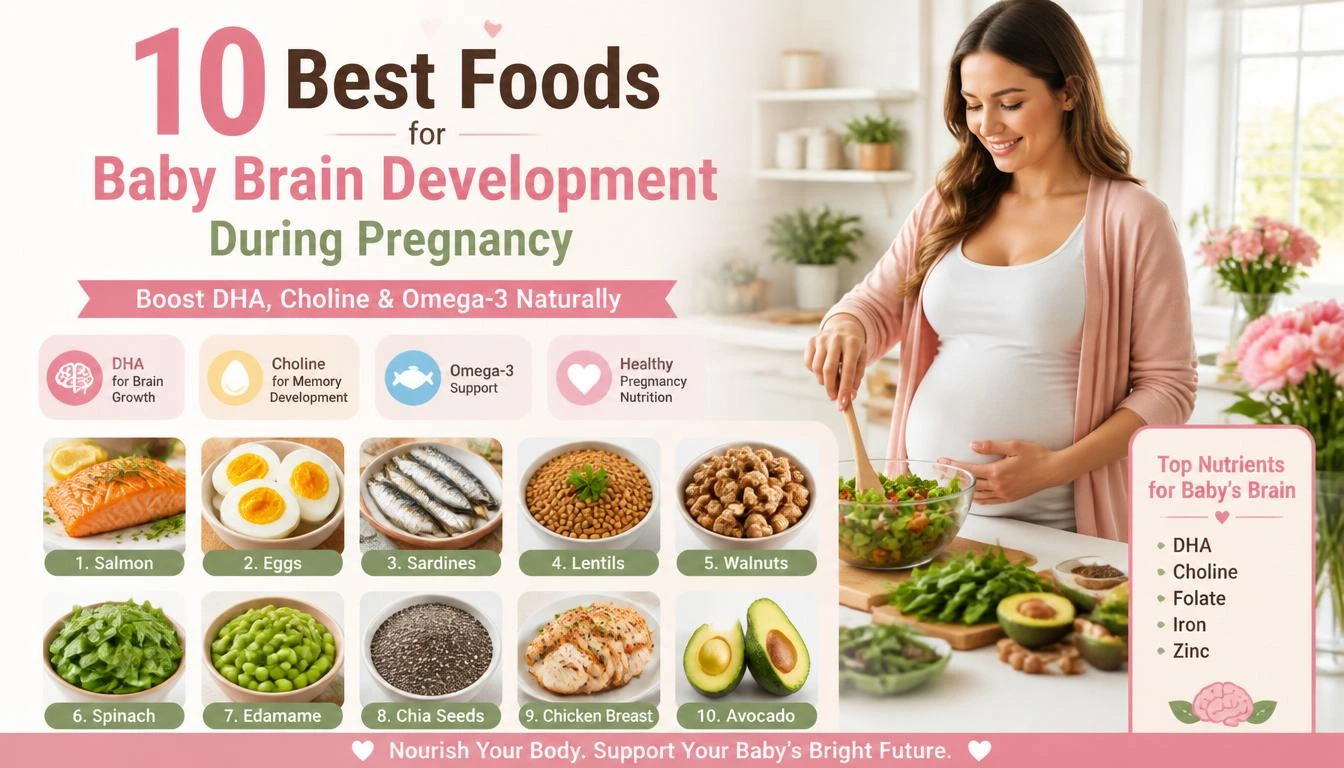
Quick Reference: Top 10 Pregnancy Brain Development Foods
- Salmon — DHA powerhouse, 2–3 servings/week
- Eggs — Best everyday choline source (294 mg per 2 eggs)
- Sardines — Affordable DHA, very low mercury
- Lentils — Folate + iron + plant protein
- Walnuts — ALA omega-3, easy daily snack
- Spinach — Folate + iron, versatile in cooking
- Edamame — Choline + plant protein, great snack
- Chia seeds — ALA + fibre, easy to add to anything
- Chicken — Choline + protein, easy to cook in bulk
- Avocado — Folate + healthy fats + choline
This article is for informational purposes only and does not replace professional medical or nutritional advice. Always discuss your specific dietary needs with your doctor or a registered dietitian during pregnancy.