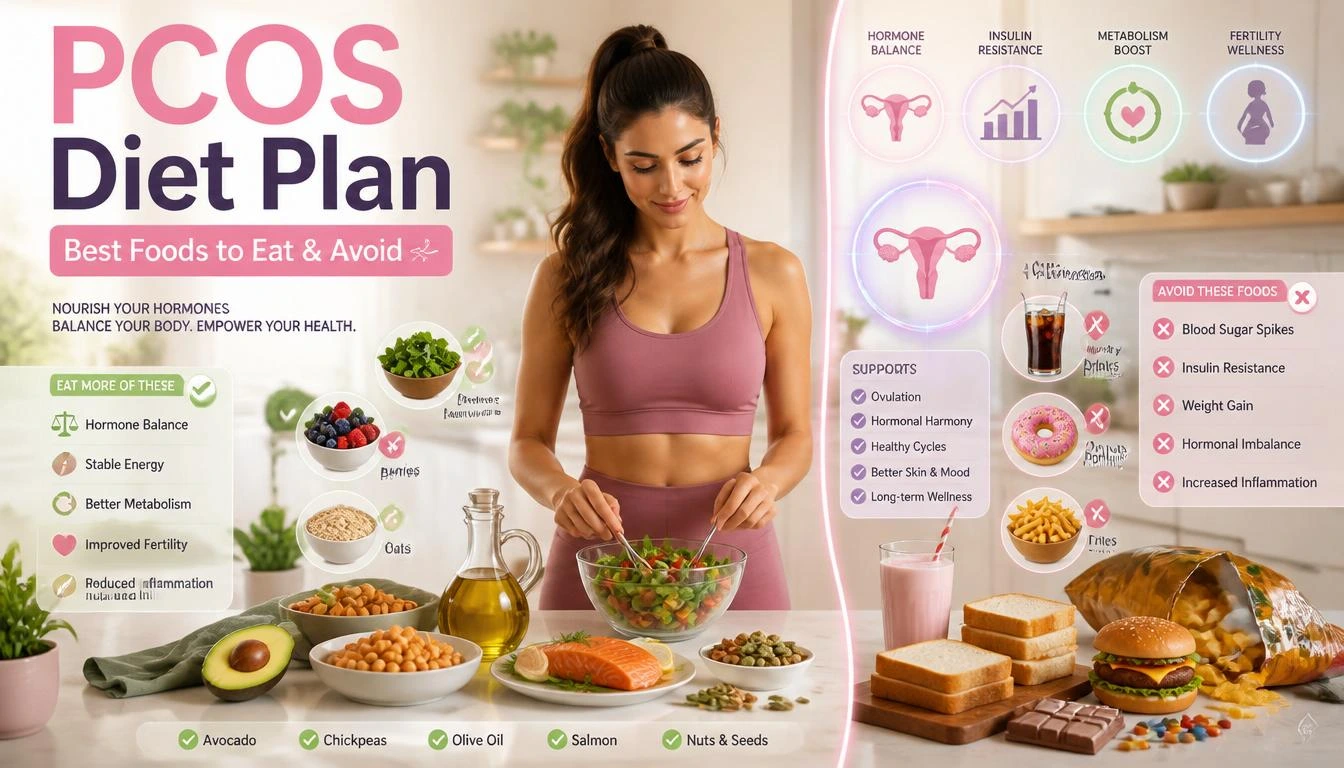
PCOS Diet Plan — If you have PCOS, you have probably been told to “eat better.” But nobody tells you exactly what that means. One source says cut all carbs. Another says fruit is fine. A third warns against dairy but cannot explain why.
It gets confusing fast.
Here is the truth: there is no single perfect PCOS diet. But there is strong evidence that certain foods make your symptoms better — and others make them much worse. Once you understand why, the whole thing becomes much simpler.
This guide covers everything you need: what to eat, what to avoid, a ready-made 7-day PCOS meal plan, and specific guidance if you are trying to get pregnant with PCOS.
Why Food Matters So Much for PCOS
Before we get into the food lists, you need to understand one thing: insulin resistance is at the root of most PCOS symptoms for up to 70% of women.
Here is what happens. Your cells stop responding well to insulin — the hormone that helps your body use glucose for energy. So your pancreas pumps out more and more insulin to compensate. All that extra insulin then signals your ovaries to produce more androgens (male hormones). Those extra androgens cause irregular periods, excess hair growth, acne, and weight gain.
This is why what you eat is not just about calories. It is about how your food affects your insulin and blood sugar levels — every single day.
The good news? The right foods can directly reduce insulin resistance. And when insulin improves, most PCOS symptoms improve too.
The Best Diet Approach for PCOS
Research consistently points to the Mediterranean diet as the best overall approach for PCOS. It is rich in anti-inflammatory foods, focuses on whole unprocessed ingredients, and is sustainable as a long-term lifestyle rather than a short-term fix.
Studies show the Mediterranean diet can improve insulin sensitivity, lower cholesterol, reduce androgen levels, and support a healthy weight in women with PCOS.
The core principles for a PCOS diet are:
- Eat foods with a low glycemic index (GI) — they release sugar slowly and keep insulin stable
- Choose high-fiber foods — fiber slows glucose absorption and feeds gut bacteria that regulate hormones
- Include lean protein at every meal — protein slows digestion and keeps you full longer
- Add anti-inflammatory foods — they reduce the chronic inflammation that makes PCOS worse
- Avoid refined carbs and added sugars — these spike insulin fast and directly worsen androgen production
PCOS Diet Plan: Best Foods to Eat
1. Leafy Green Vegetables
Spinach, kale, collard greens, methi (fenugreek), and arugula are some of the best foods you can eat with PCOS. They are low in calories, very low on the glycemic index, packed with magnesium (which helps insulin sensitivity), and loaded with anti-inflammatory antioxidants.
Eat them daily — in salads, smoothies, stir-fries, or as a side.
2. Low-Glycemic Whole Grains
Not all carbs are bad. The key is choosing ones that release energy slowly without spiking your blood sugar.
Best choices:
- Oats (rolled or steel-cut) — one of the best breakfast options for PCOS
- Quinoa — complete protein and low GI
- Brown rice — better than white but still moderate, eat in portions
- Barley — one of the lowest GI grains available
- Whole wheat roti or bread — a good replacement for refined flour versions
Avoid white bread, white rice, pasta made from refined flour, and anything made with maida.
3. Lentils, Chickpeas, and Beans (Legumes)
These are a superstar food for PCOS. They are high in both fiber and protein, which is a powerful combination for blood sugar control. They are also affordable and filling.
Good options: red lentils (masoor dal), black lentils, chickpeas (chana), kidney beans (rajma), moong dal.
Aim to eat legumes at least once a day. They pair well with brown rice, salads, soups, or as a curry.
4. Lean Protein
Protein slows down how fast carbohydrates enter your bloodstream, which prevents insulin spikes. It also keeps you full and helps preserve muscle mass — important because more muscle means a higher metabolism.
Best protein sources for PCOS:
- Eggs — especially egg whites, but whole eggs are fine in moderation
- Chicken breast and turkey — lean, easy to cook
- Fish — especially fatty fish like salmon, sardines, and tuna (rich in omega-3)
- Greek yogurt — also provides probiotics
- Paneer and tofu — great vegetarian options
- Lentils and legumes (already mentioned above)
Include at least 25–30g of protein at every main meal.
5. Berries and Low-Sugar Fruits
Fruit contains sugar, but the fiber in whole fruit slows its absorption significantly. Berries are especially good for PCOS because they are high in antioxidants and have a low glycemic index.
Best fruits for PCOS:
- Blueberries, strawberries, raspberries
- Apples and pears (eat with skin for fiber)
- Citrus fruits — lemon, orange, grapefruit
- Cherries and plums
Fruits to limit (not eliminate): mangoes, bananas, grapes, and dried fruit — these are higher in natural sugars. Eat them in small portions and always pair with protein or fat to slow sugar absorption.
Avoid fruit juice entirely — it removes the fiber and delivers pure sugar fast.
6. Healthy Fats
Fat does not make you fat — the wrong kind of fat does. Healthy fats are essential for hormone production and actually help reduce inflammation in PCOS.
Best sources:
- Avocado — one of the most nutrient-dense foods for PCOS
- Olive oil — use for cooking and dressings
- Nuts: walnuts, almonds, cashews (portion controlled)
- Seeds: flaxseed, chia seeds, pumpkin seeds — all excellent for hormonal health
- Fatty fish: salmon, mackerel, sardines — rich in omega-3 fatty acids
Omega-3 fatty acids in particular have been shown to reduce androgen levels and improve menstrual regularity in PCOS.
7. Anti-Inflammatory Foods
Research shows women with PCOS have chronic low-grade inflammation throughout the body. This inflammation stimulates the ovaries to produce more androgens, making symptoms worse.
These foods actively fight inflammation:
- Turmeric — add to curries, rice, or golden milk
- Ginger — in tea, smoothies, or cooking
- Tomatoes — high in lycopene
- Walnuts and flaxseed
- Extra virgin olive oil
- Green tea — also reduces androgen levels in some studies
- Dark leafy greens
8. High-Fiber Foods
Fiber is your best friend with PCOS. It slows down how fast food is digested, reduces the speed at which glucose enters your blood, and feeds beneficial gut bacteria that help regulate hormones.
Aim for 25–30g of fiber per day.
Top sources: oats, lentils, chickpeas, vegetables, fruits (with skin), chia seeds, flaxseed, whole grains.
PCOS Diet Plan: Foods to Avoid
1. Refined Carbohydrates
This is the biggest one. Refined carbs spike your blood sugar and insulin faster than almost anything else — directly worsening PCOS symptoms.
Avoid or significantly reduce:
- White bread, white rice, maida rotis
- Pasta made from refined flour
- Most breakfast cereals (they are often loaded with refined starch)
- White flour baked goods: biscuits, cakes, pastries, naan
Replace with whole grain versions whenever possible.
2. Added Sugar and Sugary Drinks
Sugar causes a rapid insulin spike — exactly what you need to avoid with PCOS. The liquid form is worst because it hits your bloodstream almost immediately.
Avoid:
- Soft drinks and sodas
- Packaged fruit juices
- Sports drinks and energy drinks
- Sweetened coffee drinks (caramel lattes, frappes)
- Ice cream, sweets, and desserts eaten regularly
- Sweetened yogurt (switch to plain Greek yogurt)
This does not mean you can never have something sweet. But making sugary foods a daily habit directly worsens insulin resistance over time.
3. Fried and Ultra-Processed Foods
These contain unhealthy fats, high sodium, and often hidden sugars — all of which promote inflammation and worsen PCOS.
Avoid:
- French fries and chips
- Fried chicken and fast food
- Packaged snacks, crackers, instant noodles
- Ready-to-eat meals
- Processed meats: hot dogs, salami, sausages
A useful rule: if you cannot recognize the ingredients on the label, the food is highly processed. Avoid it.
4. Saturated and Trans Fats
These fats promote inflammation and have been linked to worse insulin resistance in PCOS.
Limit:
- Butter and ghee (small amounts are fine; do not use for everything)
- Full-fat processed dairy
- Red meat eaten daily
Avoid entirely:
- Margarine and partially hydrogenated oils
- Vanaspati
- Most commercial baked goods and pastries
5. Alcohol
Alcohol is processed by the liver as a toxin — and your liver also processes excess hormones. When your liver is busy with alcohol, hormone clearance slows down, worsening androgen excess. Alcohol also raises blood sugar and disrupts sleep quality, both of which worsen PCOS.
Limit alcohol significantly or avoid it entirely if possible.
6. Dairy (Watch Your Response)
Dairy is not a universal villain for PCOS, but some women find it worsens their acne and hormonal symptoms. This is individual — some women with PCOS do fine with dairy, others do not.
If you suspect dairy is affecting you, try removing it for 4–6 weeks and see if your skin or symptoms improve. You can always reintroduce it and monitor your response.
Low-fat dairy (plain Greek yogurt, cottage cheese, low-fat milk) is generally better than full-fat dairy if you choose to include it.
7-Day PCOS Diet Meal Plan
This 7-day plan follows the PCOS diet principles above — low GI, high fiber, anti-inflammatory, and protein at every meal. Each day is around 1,400–1,600 calories, which supports gradual, sustainable weight loss.
Day 1 — Monday
Breakfast: Overnight oats made with rolled oats, chia seeds, unsweetened almond milk, and fresh blueberries. Sprinkle with a few walnuts.
Lunch: Grilled chicken breast with a large salad of spinach, cucumber, cherry tomatoes, and avocado. Dress with olive oil and lemon juice. One slice of whole grain bread.
Dinner: Red lentil dal with one whole wheat roti and steamed broccoli.
Snack: 1 apple with 1 tablespoon of almond butter.
Day 2 — Tuesday
Breakfast: 2 scrambled eggs with sautéed spinach and mushrooms. One slice of whole grain toast.
Lunch: Chickpea and vegetable soup with a side of brown rice.
Dinner: Baked salmon fillet with roasted sweet potato and steamed green beans.
Snack: A small handful of mixed nuts and a cup of green tea.
Day 3 — Wednesday
Breakfast: Greek yogurt (plain, unsweetened) with strawberries and 2 tablespoons of flaxseed.
Lunch: Quinoa salad with roasted vegetables, feta cheese (small amount), olives, and lemon-olive oil dressing.
Dinner: Moong dal with one chapati and cucumber raita (low-fat yogurt).
Snack: Sliced cucumber and carrot sticks with hummus.
Day 4 — Thursday
Breakfast: Vegetable omelette with 2 eggs, bell peppers, onion, and tomatoes. No added white flour.
Lunch: Brown rice with rajma curry and a small salad.
Dinner: Grilled chicken or tofu with stir-fried vegetables in olive oil and soy sauce.
Snack: A pear and 10 almonds.
Day 5 — Friday
Breakfast: Steel-cut oatmeal with cinnamon, sliced banana (half), and a tablespoon of peanut butter.
Lunch: Palak (spinach) soup with lentils and whole grain bread.
Dinner: Grilled fish with quinoa and a large serving of leafy salad.
Snack: Green smoothie: spinach, banana, almond milk, and chia seeds.
Day 6 — Saturday
Breakfast: 2 boiled eggs with avocado on whole grain toast. Fresh orange juice is fine but limit to a small glass — or eat the whole orange instead.
Lunch: Chana chaat (chickpea salad) with tomatoes, onion, cucumber, lemon juice, and spices. No fried papdi.
Dinner: Baked chicken thighs (skinless) with roasted cauliflower and brown rice.
Snack: Plain Greek yogurt with a few walnuts.
Day 7 — Sunday
Breakfast: Whole grain pancakes (no white flour) with fresh berries and a drizzle of raw honey.
Lunch: Vegetable biryani made with brown rice, mixed vegetables, and minimal oil. Side of plain yogurt.
Dinner: Masoor dal with 2 whole wheat rotis and steamed spinach.
Snack: A small bowl of mixed berries with a teaspoon of flaxseed.
PCOS Weight Loss: Why It Is So Hard and What to Do
One of the most frustrating things about PCOS is that standard weight loss advice — eat less, move more — often does not work as well. Women with PCOS have higher insulin levels that make fat storage easier and fat burning harder. This is not your fault. It is your biology.
But weight loss is not impossible. And even a small amount makes a big difference.
Losing just 5 to 10% of your body weight can restore regular ovulation, lower androgen levels, reduce acne and hair growth, and significantly improve your insulin sensitivity. For a woman weighing 80kg, that is just 4–8kg.
These strategies work better for PCOS weight loss than generic calorie cutting:
1. Do not skip meals. Skipping meals causes blood sugar to drop, which leads to insulin spikes when you do eat. Eat small, balanced meals every 3–4 hours.
2. Always combine carbs with protein and fat. Never eat a carb alone. Pairing rice with dal or having fruit with nuts slows down glucose absorption significantly.
3. Exercise the right way. A mix of cardio (walking, swimming, cycling) and resistance training (weights, bodyweight exercises) is most effective for PCOS. Resistance training in particular increases muscle mass, which improves insulin sensitivity long-term.
4. Eat your biggest meal earlier in the day. Eating more of your calories in the morning and afternoon — rather than at night — works better for blood sugar management with PCOS.
5. Avoid intermittent fasting if it stresses you out. Some women with PCOS do well with time-restricted eating, but others find it causes cortisol spikes that worsen hormones. If it leaves you starving and craving sugar, it is not the right approach for you.
PCOS Diet and Pregnancy: Can You Get Pregnant with PCOS?
Yes, you absolutely can get pregnant with PCOS. It is one of the most common causes of female infertility — but most women with PCOS do conceive, either naturally or with some support.
PCOS affects fertility mainly because it disrupts regular ovulation. When your ovaries do not release an egg consistently, it is harder to conceive. Diet plays a direct role in restoring ovulation because insulin resistance is the key driver.
Best Age to Get Pregnant with PCOS
The best age to get pregnant with PCOS is generally between 25 and 32. Fertility naturally declines with age for all women, and for women with PCOS, the hormonal environment can become more complex after 35. This does not mean you cannot conceive after 32 — many women do. But earlier intervention and treatment is associated with better outcomes.
How to Get Pregnant with PCOS Quickly
1. Fix your insulin resistance first. This is the most important step. Follow the PCOS diet in this guide — low GI, high fiber, lean protein — consistently for at least 3 months. Many women see their periods regulate and ovulation return within this timeframe with diet changes alone.
2. Lose weight if you are overweight. A 5–10% reduction in body weight can restore ovulation patterns. Even modest weight loss dramatically improves fertility in women with PCOS.
3. Track your ovulation. Women with PCOS have unpredictable ovulation cycles, which makes timing intercourse difficult. Use ovulation predictor kits, track basal body temperature, or ask your doctor for follicular scans to identify your fertile window.
4. Manage stress. Chronic stress raises cortisol, which worsens insulin resistance and disrupts ovulation. Include stress-reduction practices like yoga, walking, or meditation daily.
5. Take targeted supplements. Inositol (especially Myo-inositol combined with D-chiro inositol) has strong evidence for improving ovulation frequency in PCOS. Folic acid is essential for all women trying to conceive. Vitamin D deficiency is common in PCOS and supplementing it helps hormone balance. Always check with your doctor before starting supplements.
6. See a fertility specialist if needed. If you have been trying to conceive for 6–12 months without success, do not wait. A doctor can prescribe medications like Letrozole or Clomifene to stimulate ovulation. These are highly effective for PCOS-related infertility. IVF is also an option if needed.
PCOS Meal Plan Tips That Actually Make It Stick
Knowing what to eat is one thing. Actually doing it every day is another. Here are practical habits that make the PCOS diet easier to follow long-term:
Meal prep on Sundays. Cook a batch of brown rice, lentils, and roasted vegetables for the week. Having food already prepared removes the decision-making that leads to grabbing something unhealthy.
Change one thing at a time. Do not try to overhaul your entire diet at once. Start with one swap: replace white rice with brown rice this week. Next week, add a protein to breakfast. Small changes stick better than big ones.
Read ingredient labels. Look for hidden sugars — they go by many names: glucose, fructose, sucrose, corn syrup, dextrose, maltose. If any of these appear in the first five ingredients, the product is high in sugar.
Drink more water. Aim for 2–2.5 liters a day. Staying hydrated helps your body regulate blood sugar better. Replace sugary drinks one at a time.
Do not demonize a single food. PCOS management is about your overall eating pattern, not individual foods. Occasionally having white rice or a piece of cake will not derail your progress. Eating it every day will.
Can PCOS be controlled just with diet?
Diet is one of the most powerful tools for managing PCOS — especially for reducing insulin resistance. Many women see significant improvements in their periods, skin, weight, and energy levels with dietary changes alone. However, some women also benefit from medical treatment alongside diet. Work with your doctor to find the right combination for your needs.
Is the keto diet good for PCOS?
Very low carb and keto diets can help with short-term insulin control and weight loss in PCOS. But they are difficult to maintain long-term and may cause hormonal stress in some women. A low GI, balanced approach like the Mediterranean diet is generally better supported by evidence for long-term PCOS management.
Can I eat fruit if I have PCOS?
Yes, whole fruit is fine for PCOS. The fiber in whole fruit slows sugar absorption. Stick to lower-sugar fruits like berries, apples, citrus, and pears. Limit high-sugar fruits like mangoes and grapes to smaller portions. Avoid fruit juice — it removes the fiber and acts like sugar in your body.
How quickly will I see results from changing my diet with PCOS?
Most women start to notice improvements within 4–8 weeks of consistently following a PCOS-friendly diet. Blood sugar and energy levels often improve first. Menstrual cycle changes may take 2–3 months of consistent eating. Weight changes depend on your starting point and calorie balance. Be patient and consistent.
Is it okay to eat rice with PCOS?
Brown rice and other whole grains are fine in moderate portions, paired with protein and vegetables. White rice has a higher glycemic index and should be limited or swapped for brown rice, quinoa, or barley when possible. Portion size matters — a small serving of white rice with a protein-rich dal is better than a large serving of rice alone.
What is the best breakfast for PCOS?
The best PCOS breakfasts are high in protein and fiber, low in refined carbs, and include a healthy fat. Examples: scrambled eggs with vegetables and whole grain toast, overnight oats with chia seeds and berries, or Greek yogurt with flaxseed and fruit. Avoid sugary cereals, white toast with jam, and pastries.